
Rope and Research
An interview with writer Tim Queeney

I love microhistories. I love to read them as much as I love to write them. So, I was thrilled when I saw a copy of Tim Queeney’s Rope: How a Bundle of Twisted Fibers Became the Backbone of Civilization come across my desk.
Like all good microhistories, Rope uses a rather ubiquitous object (rope, in this case) to offer insights into larger historical contexts. A sailor, Tim already knew the importance of rope to nautical history, and he writes about it with passion, tracing its usage on Magellan’s global voyages to its vital role on Polynesian crab claw sails. His book examines rope’s use in construction as well, from the building of the Egyptian pyramids to the Brooklyn Bridge. Rope, it seems, has been at the heart of human progress (for better or worse) for millennia. And Tim finally gives the story its due.
I wanted to ask Tim, microhistory writer to microhistory writer, about what it was like to research his book. Below we discussed what prompted the idea to write Rope and how he structured his research. He expands the notion of “archive,” a recurring theme in this newsletter, to include the experts he interviewed for the book and offers some insight into how to make the most of interviews as a researcher. He also discusses what makes microhistories so unique among genres.
Whether you’re a researcher yourself, a reader of history, or someone as fascinated as I am by how a book comes together, this interview is for you. Enjoy!
Library of Wonders: What inspired you to write a whole book about rope?
Tim Queeney: The idea to write Rope actually came from a rope! We had sailboats when I was growing up in Connecticut so there was plenty of rope around my family’s house. After my dad died some years ago, my mom rather pointedly suggested that as the editor of a boating magazine and as a sailor myself, I should take his milk crates of boat rope home with me to Maine. I used pieces of that rope for various tasks ashore and afloat. One day I grabbed a line from the crate for some purpose. But the line was knotted in an awkward place. I was about to loosen the knot when I stopped and realized that my dad’s fingers had tied it. It was a physical sign of him still here in the world. I couldn’t untie it. I hung that line, knot intact, on the wall and began to think about rope in a way I hadn’t before. After some research I found no one had written a book about rope and its significance in human history. That seemed like a missing piece so I decided to tell that story.
LoW: What archives or objects did you explore while writing your book?
Tim: The objects I interacted with most often as I was writing were various coils of rope (as you may have guessed, I like rope!). I used those to learn some new knots, including the fabulous flying bowline, the knot that forms in midair. I did consult some very rare and arcane books that I requested via interlibrary loan (ILL). The ILL folks at the Portland and Cape Elizabeth libraries here in Maine were so helpful in making these books available to me. The best archive I explored was the people I interviewed.
I conducted 33 interviews and they were both fascinating and made a huge contribution to the book. One person I was delighted to speak with was Philippe Petit, the high wire artist who walked between the World Trade Center towers on the morning of August 7, 1974 on a length of ¾-inch wire rope. He’s 75 now and he still walks the wire. Given that he was 1,350 feet in the air as he performed his walk between the towers, I asked him if he was scared that August morning. He replied with his characteristic confidence: “It was frightening, but I was not scared!”
“Somewhat counterintuitively, by simplifying and focusing on one type of object, microhistories…reveal the incredible complexity of human history and culture.”
LoW: What surprised you the most during your research? And what was your favorite discovery?
Tim: I was surprised at the age of the oldest piece of three-strand cordage ever discovered (you can find out how old if you read my book!) It was so much older than I ever expected. It’s possible there was even older rope made by early humans but we will likely never know as rope was constructed from plant material that rotted away. A photo of rope was the thing that finally pushed me over the edge to write the book. The image was of three-strand rope that had been buried along with a deconstructed boat in a pit alongside the Great Pyramid in Egypt. The boat pit was discovered by accident in 1954. Egyptologists speculate that the boat was intended for the dead pharaoh to use in the afterlife (he would have had to reassemble it first!). Most striking for me, however, was the pile of three-strand rope also interred in the pit. It was 4,500 years old but looked like it had just been purchased from a boating supply store. The idea that the Egyptians had such robust rope making technology was amazing and inspiring.
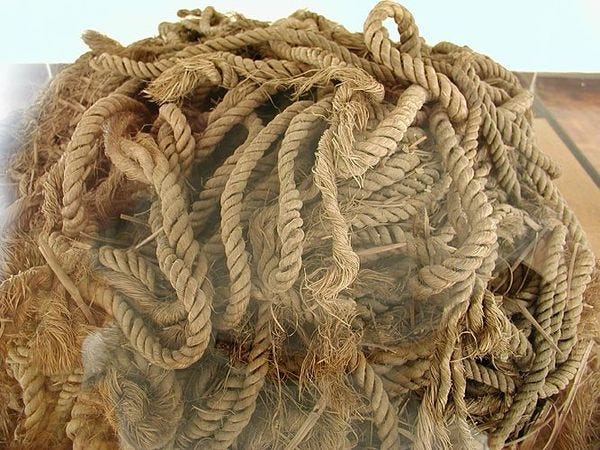
The 4,500-year-old three-strand Egyptian rope found in the boat pit alongside the Great Pyramid in 1954. The ancient Egyptians mainly used Halfa grass, a common plant found alone the Nile River, as a source of fibers to make rope. Credit: Jon Bodsworth/Wikipedia
LoW: What did you wish you knew when you started your research journey? Anything you would go back in time to tell yourself?
Tim: I would like to have structured my writing time to conduct more interviews. I think they would have added so much more to the book. One fun thing about interviews is that once you’ve finished asking your prepared set of questions and you’re simply chatting — the conversation seemingly winding down — that’s when some of the best material emerges. So, I tend to listen even more attentively during the chatting period of the interview for those sudden gems.
LoW: What do you think microhistories can tell us about the world that other types of books, perhaps, can’t tell us?
Tim: I think that somewhat counterintuitively, by simplifying and focusing on one type of object, microhistories like Rope reveal the incredible complexity of human history and culture. The story of rope is so important to human development and it touches on so many aspects of it. Yet, there are myriad objects and tools that also have fascinating stories to tell that fill in our knowledge and make surprising connections to the stories you know and the things you never considered. When you realize this, the immense cleverness of humanity becomes readily apparent. There are certainly downsides to the technologies that humans have developed through history, and recent writing has rightfully pointed those out. I think it’s a good thing to remember, however, that this technological development is an amazing testament to the human skills of observation, invention and improvement. Let’s hope we use those talents in good ways going forward.
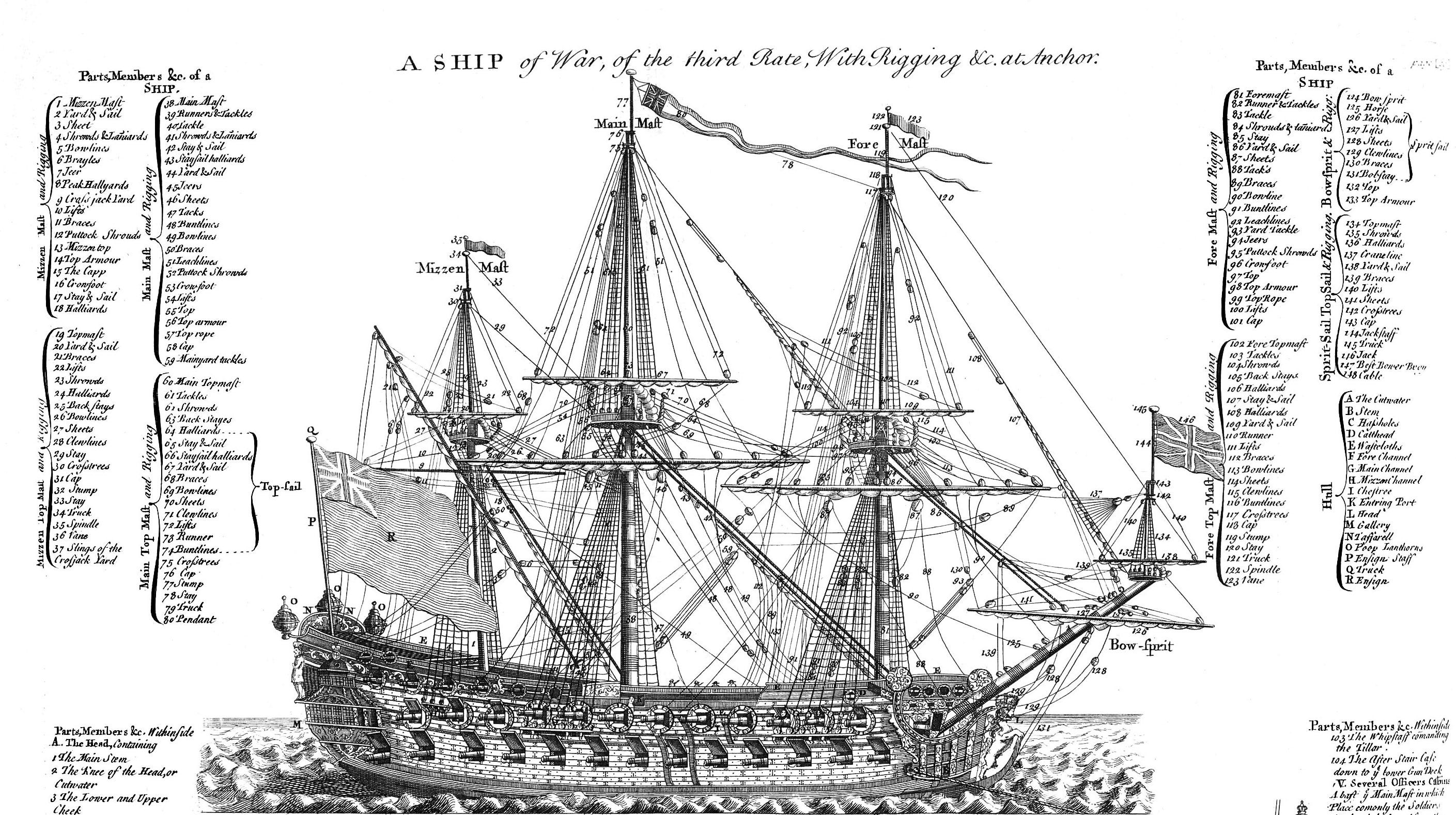
Rigging diagram of a ship from 1728 during the Age of Sail. Note all the rope required for just one vessel, a reason that rope began to be produced on an industrial scale during this period. Credit: public domain.
LoW: I love how you weave personal stories throughout the book. How did you arrive at this structure?
Tim: One of the reasons that rope hasn’t gotten much attention is its very ubiquity — rope is omnipresent and so is largely ignored! Rope has been used by people from the very beginning and in every culture up until today. So, I wanted to show how rope was this incredibly useful tool by giving examples of people using it. And nothing drives the point home more than a good story. In fact, I had far more good stories than I could fit into the book. Perhaps a Rope Reader of great rope stories is in order.
LoW: What’s next for you? Anything you’re working on now that you’d like my readers to watch for?
Tim: I’m working on another book that focuses on a single object (no surprise there!). It’s something a bit less kinetic than rope but equally important and something that has fired people’s imaginations for centuries up to the present day and certainly will in the future: maps and mapping. Thank you for the chance to talk about Rope.
More about Tim Queeney: Tim is the former editor of Ocean Navigator magazine. Tim’s work has appeared in Professional Mariner, American History, and Aviation History magazines. He has had short stories published in the crime anthology Landfall, Best New England Crime Stories 2018 and in the speculative fiction anthology A Land Without Mirrors. Tim has been interviewed on BBC Radio London, Maine Public and Connecticut Public Radio, The World on NPR, Talk Radio Europe, Late Night Live on ABC radio in Australia and on podcasts like Decoder Ring from Slate.com, History Unplugged, Something You Should Know and GarageLogic with Tommy Mischke. Tim lives in Cape Elizabeth, Maine, with his wife and a rescue dog, Frankie. A life-long sailor, he has taught celestial navigation, radar navigation and coastal piloting ashore and at sea — where he tied plenty of knots and handled many a rope. Rope is available wherever books are sold.